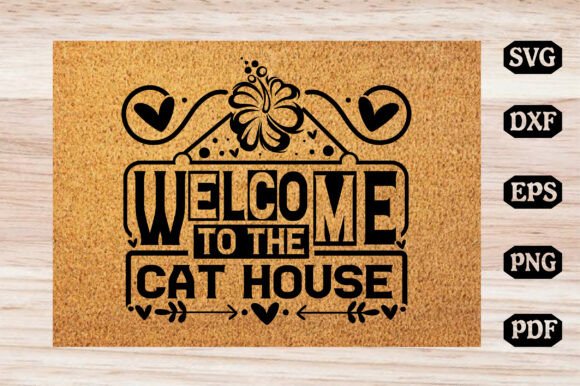
Welcome to the Cat House SVG Design
A Designer’s First Glance: Whimsy with Purpose
Opening Welcome to the Cat House Svg Design feels like unrolling a tiny invitation—playful, warm, and unmistakably feline. It’s not just “cute.” There’s intention in the curves: rounded rooflines, soft paw-print accents, and lettering that leans gently, like a cat stretching across a windowsill. As an embroidery designer who’s stitched hundreds of word-based layouts, I immediately notice how the “Word By Layer” structure suggests thoughtful layering—not just for visual depth, but for real-world stitch sequencing. This isn’t a flat graphic slapped onto fabric; it’s built to breathe under thread.
Real Project Test: Embroidering a Linen Tote for a Local Boutique
Last week, I used Welcome to the Cat House Svg Design on a natural linen tote for a small-batch boutique launch. The client wanted something cozy but polished—no kitsch, no clutter. We chose a muted sage thread on oat-colored linen, stabilized with medium-weight cutaway. The result? A design that reads clearly at 4 inches wide, holds its shape after washing, and invites touch—not just sight. Customers paused at the display rack. One said, “It makes me smile *before* I even open my bag.” That’s the quiet power of this design: it lands emotionally *and* technically.
Where It Shines (and Where It Asks for Care)
Welcome to the Cat House Svg Design excels in projects where warmth and personality matter most:
- Custom apparel: Works beautifully on crewneck sweatshirts and relaxed-fit tees—especially when paired with simple fill-stitch lettering and subtle satin-stitch outlines.
- Personalized gifts: Ideal for baby onesies (use lightweight stabilizer), nursery pillows, or tea towels meant for gifting—its gentle scale avoids overwhelming delicate items.
- Small shop merchandise: Stitches cleanly on patches, aprons, and cap fronts (with proper hooping and tear-away backing). Its layered structure helps manage stitch density so edges stay crisp, not muddy.
- Holiday and boutique branding: Fits right into spring collections, cat-themed gift sets, or local craft fair booths—feeling handmade without looking amateurish.
But—and this is key—it’s not universally forgiving. On textured fabrics like bouclé or heavy terry cloth, fine interior details (like tiny window panes or whisker-like accents) can blur. On thin knits or stretchy jersey, skip the dense fill areas unless you’re using high-quality topping and basting stitches. And if you’re planning a curved surface like a structured cap front, test the letter spacing first: tight kerning may compress unpredictably during hooping.
What It Does for Your Craft Business
As an Etsy seller and embroidery educator, I watch what builds trust—not just clicks. Welcome to the Cat House Svg Design supports professionalism in subtle but measurable ways. When stitched cleanly, it elevates perceived value: customers don’t see “SVG file,” they see “thoughtfully made.” That translates to better photo mockups, stronger social proof, and repeat buyers who associate your brand with charm *and* reliability. It also plays well with cohesive product lines—pair it with simple paw-print borders or minimalist cat silhouettes, and you’ve got a scalable design system for your craft business.
Practical Notes Every Embroiderer Should Check Before Stitching
This isn’t a “set and forget” file—even good ones demand attention. Here’s what I do before committing to a finished product:
- Test on scrap fabric that matches your final substrate—linen behaves differently than cotton poplin, and both react uniquely to the same stitch sequence.
- Review stitch density in your embroidery software. Look for overlapping fills or overly tight satin columns—these cause puckering or thread breaks on slower machines.
- Confirm hoop size compatibility. While the layout is compact, layered elements may require a 5x7” hoop minimum for clean registration.
- Inspect small details at 200% zoom: are inner corners sharp? Do letters have consistent stroke weight? If not, minor digitizing tweaks may be needed.
- Mock it up in black and white first—this reveals contrast issues before you commit to thread colors.
- Compare light vs. dark fabric backgrounds. Some layers (like subtle shadow fills) disappear on black fabric unless adjusted.
- Use appropriate stabilizer—cutaway for knits, tear-away for stable wovens, and topping for napped surfaces.
- Verify licensing terms before selling finished items or bundling as part of a digital product. This listing states “digital download only”—so confirm commercial use rights directly with the creator if you plan resale.
Final Thought: Not Just a Graphic—A Conversation Starter
In a sea of generic “cat lover” designs, Welcome to the Cat House Svg Design stands out because it doesn’t shout. It leans in. It fits naturally on a handmade pillow cover gifted to a new pet parent, on a boutique apron worn by a baker who rescues strays, or on a holiday tea towel passed down through generations. It’s a machine embroidery design that remembers it’s stitched by hand—and meant to be held, used, and loved. For crafters, Etsy sellers, and small shop owners building something real? That kind of quiet resonance is worth more than any trend.